This guide is written by the publisher of the Emotion Wheel app. You can read it without the app; we mention the app where it helps. Who writes it?

Find the Word
A guide grounded in research · in English and French

Seven ways to know what you feel.

“I'm not OK,” but what exactly? Studies suggest that putting a precise word on what you feel helps you cope with it, and that it can be learned. Here are seven ways in, each with what research shows and what it doesn't.

Before you start

Why put a word on it?

Three things research has observed, and two words of caution.

The precise word matters

In studies that follow people through their daily lives, those who tell “disappointed”, “hurt” and “ashamed” apart turn less to drinking or aggression when things go badly.

Kashdan, Barrett and McKnight, 2015

What it doesn't mean

A word isn't a cure. Naming an emotion right before trying to see it differently can make that effort work less well, at least in the moment. And using many different words for bad feelings goes with more distress, not less. Telling feelings apart may matter more than piling up words, but that's still unproven.

Nook, Satpute and Ochsner, 2021 · Vine, Boyd and Pennebaker, 2020

We don't all start from the same place.

Some days, all you notice is a knot in your stomach. Other days, the word comes on its own. Two researchers described five steps. We each have a usual step, but we move up and down from one moment to the next.

  1. The body

    “My throat feels tight.”

  2. The urge to act

    “I feel bad, I want to leave.”

  3. One word

    “I'm sad.”

  4. Several words

    “I'm sad, and relieved too.”

  5. In me and in others

    “I'm relieved, but a bit guilty; I think she's disappointed and worried.”

The seven ways below don't all start from the same step: some start from the body, others from the urge to act or a first word. Pick the one you can reach today. Surveys in Finland and Germany suggest that about one person in ten finds it much harder to put feelings into words. It isn't a diagnosis, but a trait that varies from one person to another.

Lane and Schwartz, 1987 · Lane and Smith, 2021 · Mattila et al., 2006 · Franz et al., 2008 · Parker et al., 2008

Seven ways to find the word.

Each one fits in a question and takes two minutes to try. None works for everyone: try two or three.

  1. 1Through the body

    Where do I feel it?

    Try it

    Stop for ten seconds. Where do you feel something: your throat, chest, stomach, jaw, shoulders? Is it tight, heavy, warm, restless? Describe the sensation before looking for the word.

    What research says

    Asked to color in, on a body outline, where they felt activity rise or fall, 701 people, mostly Finnish, drew maps that change from one emotion to another; two small groups of Swedish and Taiwanese speakers drew similar ones. These are drawings of what people feel, not body measurements.

    Nummenmaa et al., 2014

  2. 2Through two questions

    Pleasant or unpleasant? Agitated or calm?

    Try it

    Answer without thinking. Unpleasant and agitated: you're tense. Pleasant and agitated: fired up. Unpleasant and calm: low. Pleasant and calm: at ease. The word you're looking for is in that corner.

    What research says

    These two axes can place most emotion words on a single map. They give a neighborhood, not an address: anger and fear sit side by side.

    Russell, 1980 · Russell, 2003

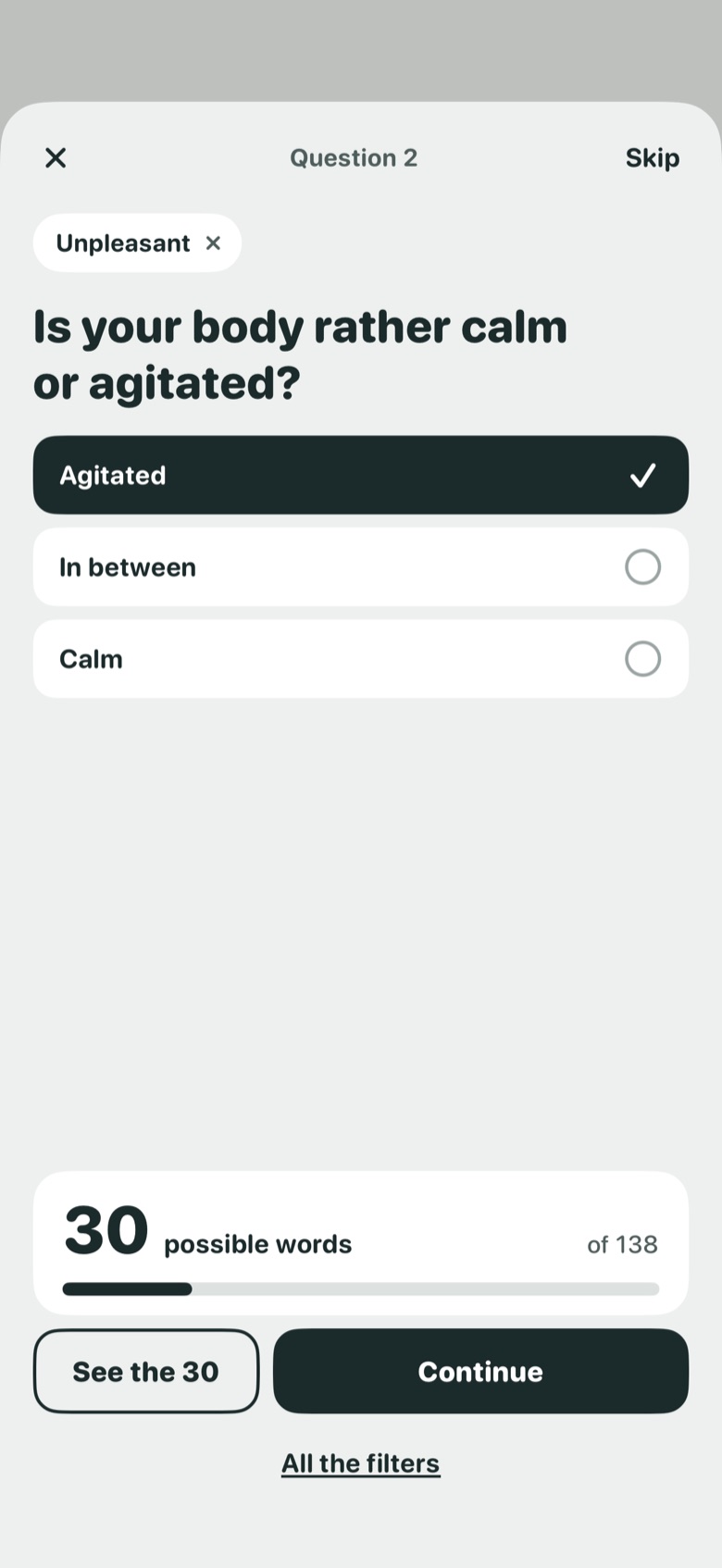
    In the appThese are its first two questions, free.

  3. 3Through words

    Which word, from broad to precise?

    Try it

    Start from a broad word: fear, anger, sadness, joy. Then narrow it down: irritated, frustrated or exasperated? Try each word in the sentence “I feel…” and keep the one that rings true.

    What research says

    Wheels and word lists are everywhere, in therapy and at school, but we found very few studies measuring what they change. Their support comes mostly from the studies on the precise word, above.

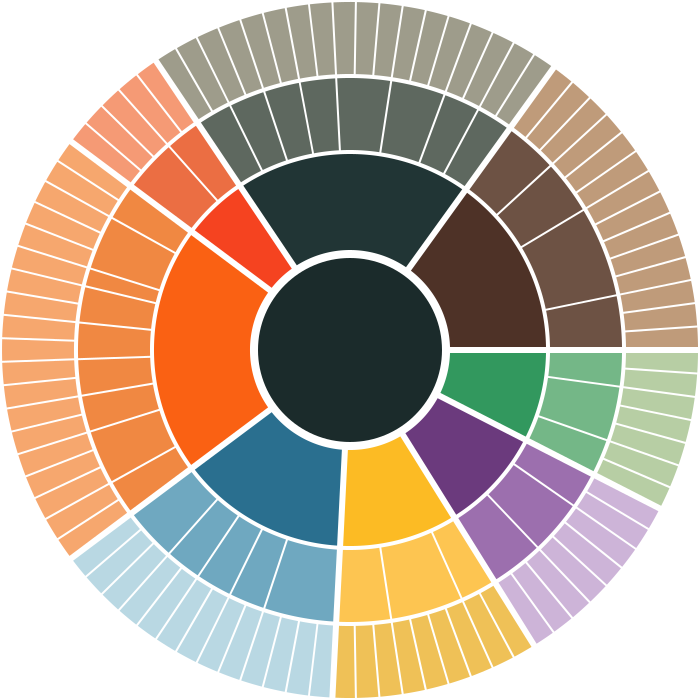
    In the appIts wheel: 138 emotions, a definition for each, free.

  4. 4Through what happened

    What does it mean for me?

    Try it

    Finish the sentence: “What happened was…, and for me it means…” A loss? A threat? An obstacle? Something unfair? The same news can sadden one person and anger another: the meaning you give it shapes much of the emotion.

    What research says

    It's the central idea of a major school in the psychology of emotion: each emotion answers a way of reading the situation, sadness a loss, fear a threat, anger a wrong. Researchers still debate it.

    Lazarus, 1991 · Moors et al., 2013

    In the appThe question “What triggered it?”, in the full version.

  5. 5Through the urge to act

    What do I feel like doing?

    Try it

    If nothing held you back, right now: move closer, lash out, run away, hide, make amends, freeze? The urge helps tell apart emotions that look alike: shame often makes you want to hide, guilt to make amends.

    What research says

    For the psychologist Nico Frijda, an emotion is first of all an urge to act, whether or not you give in to it. It's also the second of the five steps.

    Frijda et al., 2014 · Frijda, Kuipers and ter Schure, 1989 · Tangney, Stuewig and Mashek, 2007

    In the appThe question “What do you feel like doing?”, in the full version.

  6. 6By noticing, without judging

    What's here, right now?

    Try it

    For one minute, silently name what goes by, without judging it or trying to change it: “there's tension”, “there's worry”. Saying “there's” rather than “I am” leaves a little room.

    What research says

    In one small study, among people who pay more attention to the present moment, naming the emotion on a face went with a weaker response in an alarm area of the brain. Mindfulness exercises, for their part, have rarely been tested one piece at a time.

    Creswell et al., 2007 · Stein and Witkiewitz, 2020

  7. 7By writing, and coming back to it

    What do I notice from one day to the next?

    Try it

    Tonight, write three lines: what happened, what you felt, the most accurate word. Do it again tomorrow. After a week, read it back.

    What research says

    Putting what you go through into words, mostly in writing, has on average a real but small effect, according to 146 studies pooled together. And noting what you feel often seems to help in telling emotions apart.

    Frattaroli, 2006 · Hoemann, Barrett and Quigley, 2021

    In the appIts journal, which stays on your iPhone; writing in it takes the full version.

Our app

Emotion Wheel brings together five of these seven ways.

A wheel of 138 emotions with a one-sentence definition for each, questions that start from what you feel, and a journal that stays on your iPhone. Free, with a subscription to go further.

Coming soon to the App Store See the app on emotion-wheel.com
Screenshot of the app: the second question, “Is your body rather calm or agitated?”.

This guide doesn't diagnose anything.

It helps you put a word on what you feel; it doesn't replace a professional.

If you're not doing well

Don't wait to ask for help: talk to someone you trust or to a health professional. In an emergency, call your local emergency services.

Who writes this guide?

Written by
The publisher of the Emotion Wheel app, who is not a psychologist. The guide promotes the app, and says so. About
Reviewed by
To come: we're looking for a mental health professional to review the guide.
Sources
Every study cited is linked under the sentence that sums it up, and all are listed below. The sources
Last updated
October 14, 2026

Sources

The studies cited on this page, in the order they appear.

  1. Torre, J. B., & Lieberman, M. D. (2018). Putting feelings into words: Affect labeling as implicit emotion regulation. Emotion Review, 10(2), 116-124. doi.org/10.1177/1754073917742706
  2. Kircanski, K., Lieberman, M. D., & Craske, M. G. (2012). Feelings into words: Contributions of language to exposure therapy. Psychological Science, 23(10), 1086-1091. doi.org/10.1177/0956797612443830
  3. Kashdan, T. B., Barrett, L. F., & McKnight, P. E. (2015). Unpacking emotion differentiation: Transforming unpleasant experience by perceiving distinctions in negativity. Current Directions in Psychological Science, 24(1), 10-16. doi.org/10.1177/0963721414550708
  4. Hoemann, K., Barrett, L. F., & Quigley, K. S. (2021). Emotional granularity increases with intensive ambulatory assessment: Methodological and individual factors influence how much. Frontiers in Psychology, 12, 704125. doi.org/10.3389/fpsyg.2021.704125
  5. Widdershoven, R. L. A., Wichers, M., Kuppens, P., Hartmann, J. A., Menne-Lothmann, C., Simons, C. J. P., & Bastiaansen, J. A. (2019). Effect of self-monitoring through experience sampling on emotion differentiation in depression. Journal of Affective Disorders, 244, 71-77. doi.org/10.1016/j.jad.2018.10.092
  6. Vedernikova, E., Kuppens, P., & Erbas, Y. (2021). From knowledge to differentiation: Increasing emotion knowledge through an intervention increases negative emotion differentiation. Frontiers in Psychology, 12, 703757. doi.org/10.3389/fpsyg.2021.703757
  7. Nook, E. C., Satpute, A. B., & Ochsner, K. N. (2021). Emotion naming impedes both cognitive reappraisal and mindful acceptance strategies of emotion regulation. Affective Science, 2(2), 187-198. doi.org/10.1007/s42761-021-00036-y
  8. Vine, V., Boyd, R. L., & Pennebaker, J. W. (2020). Natural emotion vocabularies as windows on distress and well-being. Nature Communications, 11, 4525. doi.org/10.1038/s41467-020-18349-0
  9. Lane, R. D., & Schwartz, G. E. (1987). Levels of emotional awareness: A cognitive-developmental theory and its application to psychopathology. American Journal of Psychiatry, 144(2), 133-143. doi.org/10.1176/ajp.144.2.133
  10. Lane, R. D., & Smith, R. (2021). Levels of emotional awareness: Theory and measurement of a socio-emotional skill. Journal of Intelligence, 9(3), 42. doi.org/10.3390/jintelligence9030042
  11. Mattila, A. K., Salminen, J. K., Nummi, T., & Joukamaa, M. (2006). Age is strongly associated with alexithymia in the general population. Journal of Psychosomatic Research, 61(5), 629-635. doi.org/10.1016/j.jpsychores.2006.04.013
  12. Franz, M., Popp, K., Schaefer, R., Sitte, W., Schneider, C., Hardt, J., Decker, O., & Braehler, E. (2008). Alexithymia in the German general population. Social Psychiatry and Psychiatric Epidemiology, 43(1), 54-62. doi.org/10.1007/s00127-007-0265-1
  13. Parker, J. D. A., Keefer, K. V., Taylor, G. J., & Bagby, R. M. (2008). Latent structure of the alexithymia construct: A taxometric investigation. Psychological Assessment, 20(4), 385-396. doi.org/10.1037/a0014262
  14. Nummenmaa, L., Glerean, E., Hari, R., & Hietanen, J. K. (2014). Bodily maps of emotions. Proceedings of the National Academy of Sciences, 111(2), 646-651. doi.org/10.1073/pnas.1321664111
  15. Russell, J. A. (1980). A circumplex model of affect. Journal of Personality and Social Psychology, 39(6), 1161-1178. doi.org/10.1037/h0077714
  16. Russell, J. A. (2003). Core affect and the psychological construction of emotion. Psychological Review, 110(1), 145-172. doi.org/10.1037/0033-295X.110.1.145
  17. Lazarus, R. S. (1991). Progress on a cognitive-motivational-relational theory of emotion. American Psychologist, 46(8), 819-834. doi.org/10.1037/0003-066X.46.8.819
  18. Moors, A., Ellsworth, P. C., Scherer, K. R., & Frijda, N. H. (2013). Appraisal theories of emotion: State of the art and future development. Emotion Review, 5(2), 119-124. doi.org/10.1177/1754073912468165
  19. Frijda, N. H., Ridderinkhof, K. R., & Rietveld, E. (2014). Impulsive action: Emotional impulses and their control. Frontiers in Psychology, 5, 518. doi.org/10.3389/fpsyg.2014.00518
  20. Frijda, N. H., Kuipers, P., & ter Schure, E. (1989). Relations among emotion, appraisal, and emotional action readiness. Journal of Personality and Social Psychology, 57(2), 212-228. doi.org/10.1037/0022-3514.57.2.212
  21. Tangney, J. P., Stuewig, J., & Mashek, D. J. (2007). Moral emotions and moral behavior. Annual Review of Psychology, 58, 345-372. doi.org/10.1146/annurev.psych.56.091103.070145
  22. Creswell, J. D., Way, B. M., Eisenberger, N. I., & Lieberman, M. D. (2007). Neural correlates of dispositional mindfulness during affect labeling. Psychosomatic Medicine, 69(6), 560-565. doi.org/10.1097/PSY.0b013e3180f6171f
  23. Stein, E., & Witkiewitz, K. (2020). Dismantling mindfulness-based programs: A systematic review to identify active components of treatment. Mindfulness, 11(11), 2470-2485. doi.org/10.1007/s12671-020-01444-0
  24. Frattaroli, J. (2006). Experimental disclosure and its moderators: A meta-analysis. Psychological Bulletin, 132(6), 823-865. doi.org/10.1037/0033-2909.132.6.823